
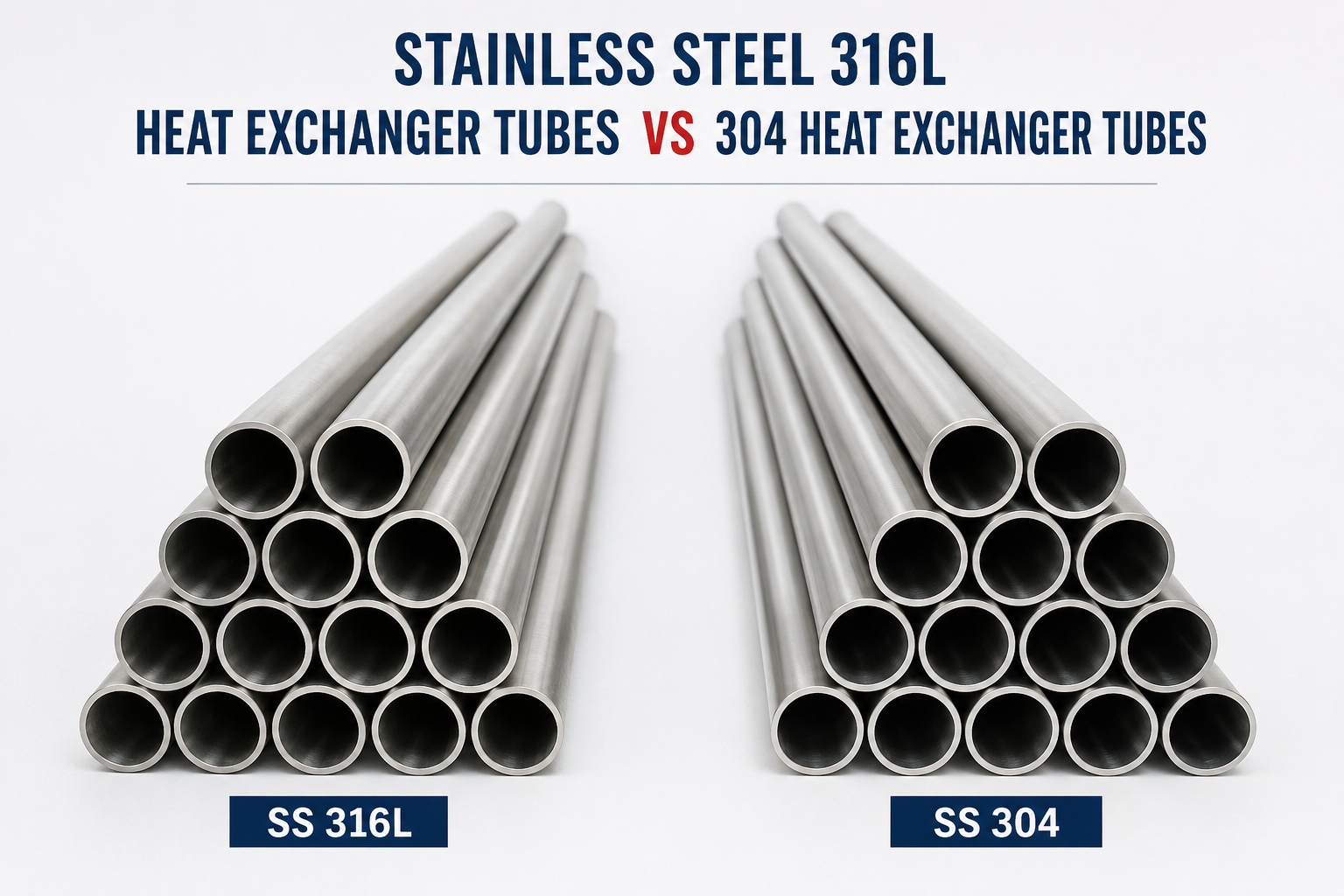
A heat exchanger tube sits in constant contact with process fluids, cooling water, and temperature swings for years without a break. Choosing between stainless steel 316L heat exchanger tubes vs 304 determines how long those tubes last before pitting, cracking, or fouling forces a shutdown. SS 304 costs less upfront. SS 316L resists chlorides and acidic media that 304 cannot handle long term. The right pick depends on what runs through the tube, not just the purchase price.
SS 316L vs 304 Heat Exchanger Tubes Comparison
Both grades belong to the austenitic stainless family and are available as stainless steel seamless tubes for heat exchanger service. Alloy content defines how each performs under heat and pressure.
| Property | SS 304 | SS 316L |
| Chemical Composition | 18-20% Cr, 8-10.5% Ni, up to 0.08% C, no molybdenum | 16-18% Cr, 10-14% Ni, 2-3% Mo, up to 0.03% C |
| Corrosion Resistance | PREN near 19, resists atmospheric and mild acidic exposure, pits in chloride-bearing water | PREN near 26, molybdenum content resists pitting and crevice corrosion in chloride and marine service |
| Temperature Resistance | Continuous service to 870°C, intermittent to 925°C | Continuous service to 800°C, retains creep strength better up to 500°C |
| Mechanical Strength | 515 MPa min tensile, 205 MPa min yield | 485 MPa min tensile, 170 MPa min yield |
| Weldability | Welds easily but sensitizes between 425°C and 815°C without post-weld treatment | Low carbon content resists sensitization, suited to heavy-gauge welds without PWHT |
| Cost | 15-25% lower material cost | Higher due to added nickel and molybdenum |
SS 316L vs SS 304 Heat Exchanger Tubes Applications
Industry conditions determine which grade delivers a longer service life in stainless steel U tubes and straight exchanger runs across six sectors.
Food Processing
Dairy lines and general food equipment run well on SS 304 tubes since exposure stays mild. Plants using chlorinated cleaners or saline brines should upgrade to SS 316L for pitting resistance.
Chemical Processing
Mild reagents and non-corrosive process streams work fine with SS 304. Aggressive acids, chlorides, and solvent-heavy processes call for SS 316L, since molybdenum content resists the pitting that shortens tube life in these plants.
Marine
Saltwater exposure rules out SS 304 entirely, since chloride ions attack its surface within months. SS 316L handles seawater cooling circuits and offshore condensers, making it the grade specified for marine heat exchangers.
Pharmaceutical
Purified water systems and general processing equipment often use SS 304 tubes. Injectable-grade water, cleaning-in-place cycles and sterilization steps favor SS 316L, since repeated chemical exposure demands stronger pitting resistance over the tube’s lifecycle.
HVAC
Standard air conditioning and chilled water systems run efficiently on SS 304, which handles the mild water chemistry found in most commercial buildings. SS 316L suits coastal HVAC installations where humid, salt-laden air accelerates corrosion.
Water Treatment
Freshwater treatment plants with low chloride content operate reliably on SS 304 tubes. Desalination units, brackish water systems and plants dosing chlorine-based disinfectants need SS 316L to prevent premature pitting and crevice corrosion.
Which Heat Exchanger Tube Should You Choose?
Matching tube grade to operating conditions avoids premature failure and unplanned downtime. These two situations cover almost all heat exchanger buying decisions in industrial plants.
Choose SS 304 When
SS 304 is suitable for budget-conscious projects and general industrial service where exposure to chlorides is low. Fabrication is easy as no special procedures are needed to form and weld the alloy. Material costs are 15 to 25% lower than equivalent 316L materials.
Choose SS 316L When
Chloride-rich process streams, marine installations and offshore condensers demand SS 316L U tubes for reliable corrosion resistance over decades of service. The low carbon content also welds cleanly on heavy gauge tubing without post-weld heat treatment.
MBM TUBES manufactures both grades as seamless and U-tube configurations, tested in-house before dispatch.
Conclusion
SS 304 and SS 316L both weld readily and hold up in heat exchanger duty, yet chloride exposure separates their long-term performance. SS 304 saves money upfront where water chemistry stays mild. SS 316L costs more at purchase but avoids pitting and crevice failures in high-chloride or offshore environments, cutting replacement frequency and lowering total lifecycle cost.


