
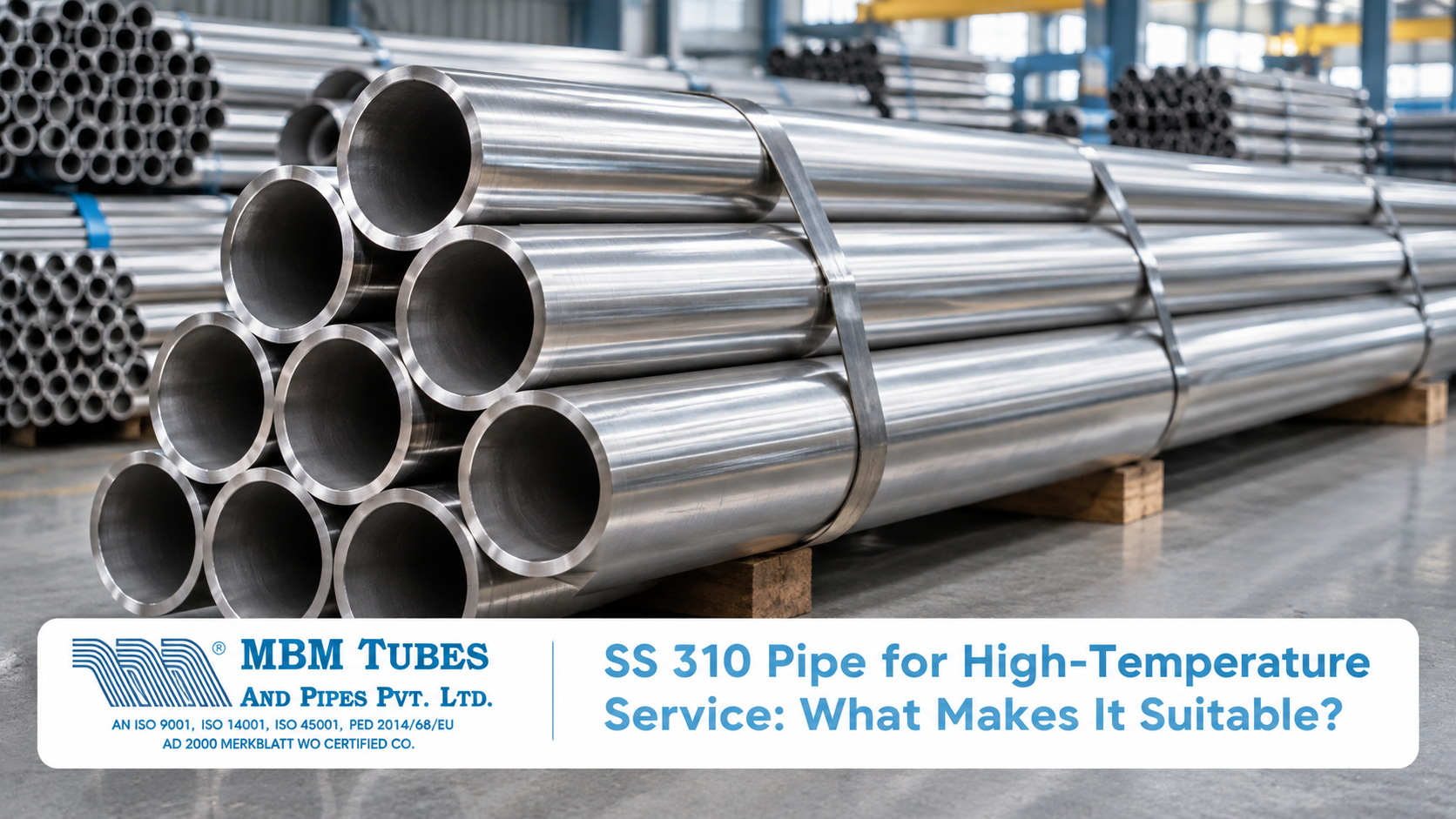
Furnace walls, radiant tubes, and high-temperature process lines push piping past the point where ordinary stainless steel scales or loses strength. Stainless steel 310 pipe holds up in these conditions. Oxidation resistance, thermal stability, and mechanical performance decide whether a pipe survives years of service or fails within a few thermal cycles. This article discusses the composition, important properties, applications, different grades and selection factors of SS 310.
What Is Stainless Steel 310 Pipe?
SS 310 is an austenitic chromium-nickel stainless steel designed for heat rather than general corrosion service. It contains 24-26% chromium and 19-22% nickel, which gives it better oxidation resistance and high temperature strength than the 304 or 316 grades. Three variants sit within this family: 310 for general high-temperature use, 310S with lower carbon for better weldability, and 310H with controlled higher carbon for sustained-temperature strength. Product forms are typically supplied to ASTM A312, A213, or A358, depending on whether the requirement is seamless, welded, or heat-exchanger tube.
Why Is SS 310 Pipe Suitable for High-Temperature Service?
Excellent Oxidation Resistance
Chromium above 24% forms a stable oxide layer that limits scaling at high temperatures, making SS 310 pipe a practical fit for hot-air ducting and furnace components. The film self-repairs when disturbed by abrasion or thermal shock.
Good High-Temperature Corrosion Resistance
SS 310 resists corrosion in oxidizing atmospheres and performs reasonably in select carburizing conditions, though results depend on process chemistry. Sulfur-bearing environments attack the material faster than a clean oxidizing one, so conditions need case-by-case review.
Mechanical Stability at Elevated Temperatures
A pipe that softens under load defeats the purpose of choosing heat-resistant material. SS 310 retains a useful share of its strength at elevated temperatures, keeping wall sections stable under pressure. Creep becomes a real factor during prolonged exposure and feeds into wall thickness calculations.
Thermal Cycling and Heat Resistance
Furnace tubes rarely sit at one steady temperature. Each expansion and contraction from repeated heating and cooling increases the stress. SS 310 is more tolerant to this cycling than the lower alloy grades, but thermal expansion must still be considered in pipe support design.
Key Properties of Stainless Steel 310 Pipe
- The austenitic microstructure resists phase transformation under sustained heat.
- High chromium and nickel content drives oxidation resistance and elevated-temperature strength.
- The chromium oxide layer protects the surface from scaling in continuous high-heat service.
- High-temperature corrosion resistance extends service life in select carburizing atmospheres.
- Good ductility and weldability allow fabrication into furnace and heat-exchanger geometries.
- Resistance to thermal fatigue supports repeated heating and cooling cycles.
Grades 310, 310S, and 310H are recognized as heat-resistant stainless steels, though none should be picked on temperature alone.
Stainless Steel 310 vs 310S vs 310H
Choosing between the three comes down to carbon content, strength needs, and fabrication requirements.
| Grade | Main Characteristic | Typical Selection Consideration |
| 310 | General high-temperature grade | Elevated-temperature applications |
| 310S | Lower carbon version | Improved weldability, lower sensitization risk |
| 310H | Controlled higher carbon | Higher-temperature strength requirements |
Selection must consider not only maximum temperature but also exposure conditions, welding requirements and section thickness. Generally, 310H is suited to applications where elevated-temperature strength is most important, and 310S works well where weld integrity is more important than peak heat resistance.
Applications of SS 310 Pipe in High-Temperature Industries
- Furnace and heat-treatment equipment use SS 310 for radiant tubes and muffle components.
- Heat exchangers rely on the grade where process-side temperatures exceed standard tubing limits.
- Thermowells built from SS 310 protect temperature sensors inside high-heat process streams.
- Petrochemical and oil-industry equipment specifies the grade for elevated refining temperatures.
- Power-generation equipment uses SS 310 tubing where flue gas heat exceeds standard limits.
- Cement and metal-processing industries select the grade for kiln-adjacent piping.
Factors to Consider When Selecting Stainless Steel 310 Pipe
- Operating and design temperatures determine whether 310, 310S, or 310H fits the service window.
- Continuous versus cyclic heating shifts the priority between oxidation and thermal-fatigue resistance.
- The process atmosphere affects how long the oxide layer holds up.
- Pressure and mechanical loading influence wall thickness and schedule.
- Welding needs often point to 310S, since it reduces sensitization risk.
- Applicable ASTM and ASME specifications guide acceptable chemistry and testing.
- Material Test Certificates confirm the delivered pipe matches the specified grade.
At some intermediate ranges, long exposure can produce sigma phase embrittlement and reduce toughness even as the pipe still resists oxidation. It’s not only temperature. But we need to take a comprehensive look at service conditions.
Conclusion
Stainless steel 310 pipe is commonly used in high-temperature systems for its oxidation resistance, high-temperature corrosion resistance, and mechanical stability under sustained heat. This balance is critical to heat exchangers, furnace equipment and power-generation piping where failure due to scaling, creep or thermal fatigue can occur. Buy SS 310 and 310S pipes and tubes for high temperature service from MBM Tubes and Pipes Pvt. Ltd.


