
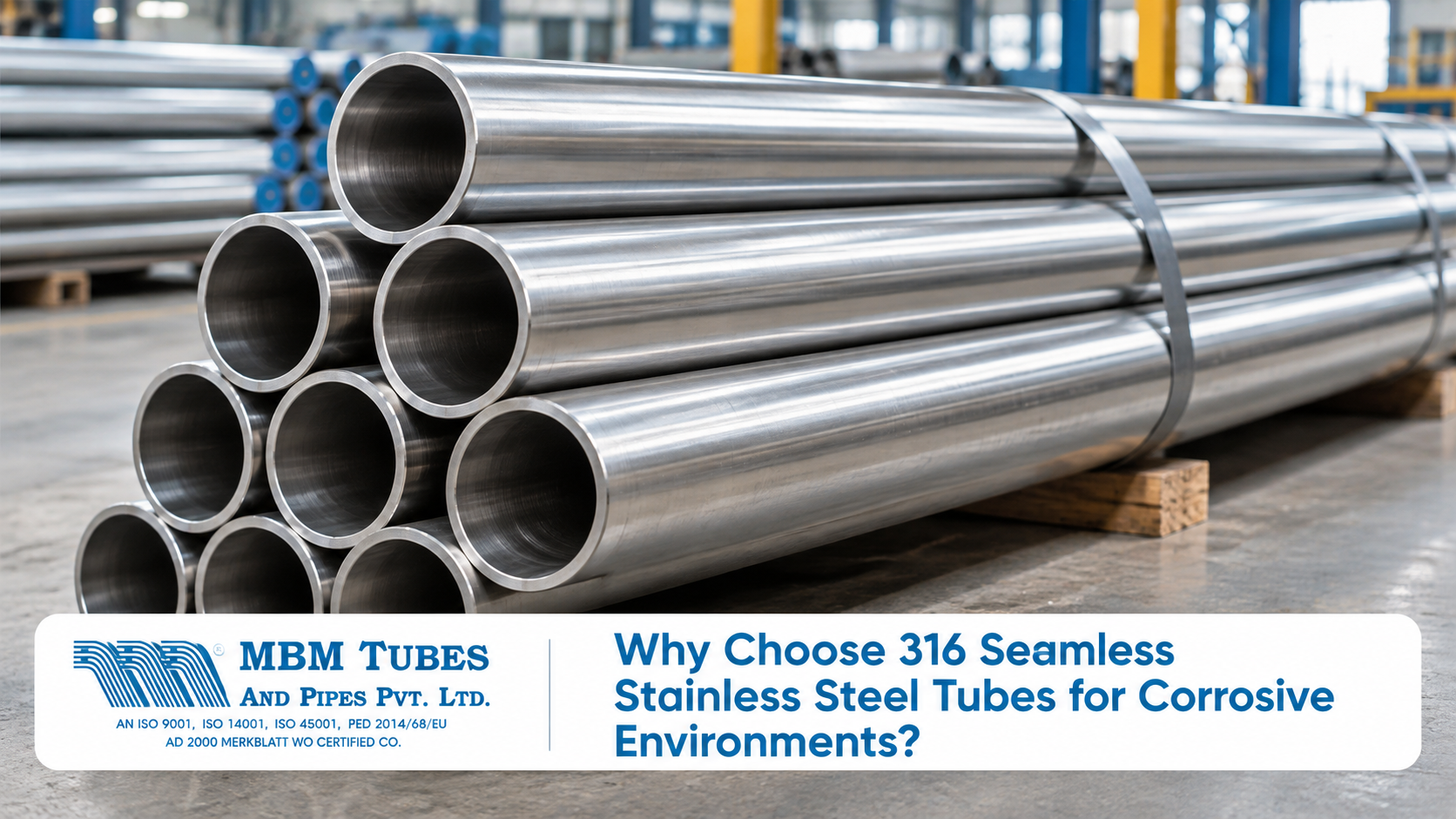
Industrial fluid systems fail most often where material meets chemistry. A 316 Seamless Stainless Steel Tube withstands that meeting point better than many general-purpose grades. When tubing carries acids, saline water, or aggressive process fluids, the metal wall becomes the first defense against leaks and downtime. Molybdenum, added to Grade 316 alongside chromium and nickel, strengthens the passive oxide layer that resists localized attack from chlorides and moisture. In this article, we will discuss the properties, benefits, applications and factors for selection while specifying a 316 Seamless Stainless Steel Tube and also compare it against Grade 304.
What Is a 316 Seamless Stainless Steel Tube?
Grade 316 is an austenitic stainless steel alloy containing chromium, nickel, and molybdenum, formulated for chemically demanding service. A seamless tube is drawn or extruded from a solid billet, without any longitudinal welded joint. That construction removes the weld seam as a potential weak point, which matters where wall consistency affects pressure containment or fluid purity. Engineers specify seamless construction for tubing exposed to high pressure or thermal cycling.
Properties and Benefits of 316 Seamless Stainless Steel Tubes
Corrosion and Pitting Resistance
Molybdenum increases resistance to pitting and crevice corrosion compared to molybdenum-free grades. This is important in chloride environments such as splash zones in seawater and some acid streams. Actual performance depends on the chloride concentration, temperature and the particular service fluid.
Mechanical Strength and Durability
Tubing under pressure requires strength and ductility to survive installation stress and thermal cycling without cracking. Grade 316 offers dependable performance in the service conditions for which it is rated. The load ratings are a function of alloy grade, wall thickness and governing specification.
Fabrication and Service Performance
Grade 316 seamless tubing bends, welds, and forms using standard stainless fabrication methods, supporting its use in fluid-handling systems and heat exchanger bundles. Temperature and pressure suitability still requires evaluation against the applicable design code.
Long-Term Operational Value
Using a service fluid compatible grade reduces the risk of early wall thinning or leaks, resulting in fewer unscheduled shutdowns. Actual service life still depends on maintenance and fluid chemistry rather than a fixed guarantee.
Applications of 316 Seamless Stainless Steel Tubes
Chemical and Process Industries
Process lines route acids, solvents, and reactive intermediates through tubing selected for compatibility with those media. 316 Seamless Stainless Steel Tube finds use across chemical processing and fertilizer applications.
Marine and Coastal Applications
Grade 316 is frequently the material of choice for offshore related tubing, as molybdenum offers pitting resistance to equipment exposed to salt spray and chloride bearing waters.
Food and Pharmaceutical Industries
Processing systems require corrosion-resistant tubing that will not contaminate the product stream. Grade 316 appears across dairy and food processing lines where the specification permits its use.
Heat Exchangers and Industrial Equipment
Heat-transfer equipment uses seamless tubing selected for the fluid, pressure, and temperature on each side of the exchanger, with final grade selection depending on the applicable design specification.
316 Seamless Tube vs 304 Stainless Steel Tube
Grade 304 and Grade 316 share the same austenitic structure, but molybdenum content in 316 sets the two apart in chloride exposure and corrosion resistance. In many cases, 316 is the standard option for extreme corrosive environments like marine atmospheres where 304 is inadequate. That advantage is achieved at a higher material cost which keeps Grade 304 relevant for general purpose applications with low chloride exposure. No one grade is better than the other; which is better depends on the service conditions and specifications.
| Factor | 316 Stainless Steel Tube | 304 Stainless Steel Tube |
| Corrosion Resistance | Higher resistance in many chloride environments | Good general corrosion resistance |
| Molybdenum | Contains molybdenum | Generally does not |
| Chloride Exposure | Often preferred for demanding conditions | Less suitable for severe chloride exposure |
| Cost | Generally higher | Generally lower |
| Selection | Depends on service conditions | Depends on service conditions |
How to Select and Verify 316 Seamless Stainless Steel Tubes
- Confirm the outside diameter and wall thickness against the design requirements before ordering.
- Specify the required tube length, accounting for any fabrication allowance.
- Match the tube rating against the actual operating pressure and temperature.
- Review the chemical composition of the service medium to confirm alloy compatibility.
- Assess chloride concentration and corrosion exposure at the installation site.
- Identify the applicable ASTM or ASME specification, such as A213 or A312.
- Check surface finish and dimensional tolerance against the equipment drawing.
- Request chemical and mechanical test results from the supplier.
- Obtain a Material Test Certificate (MTC) for the specific heat or batch supplied.
- Confirm heat and batch traceability where required.
- Clarify inspection and testing requirements, including hydrostatic testing, ahead of dispatch.
- Review the supplier’s quality documentation and inspection reports.
Conclusion
A 316 Seamless Stainless Steel Tube combines pitting resistance, dependable mechanical behavior, and fabrication characteristics suited to aggressive process media. This combination makes it suitable for use in chemical, marine, food, pharmaceutical and heat exchanger applications where exposure to chloride requires more than a standard grade. Evaluate service conditions, dimensions, specifications and supplier documentation before placing any order. Contact MBM Tubes and Pipes Pvt. Ltd. for technical details and pricing on our 316 Seamless U-Tubes range.


